期刊信息

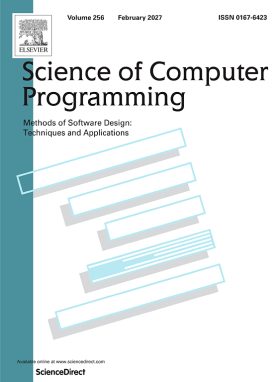
Science of Computer Programming 的封面
封面版权归出版方所有

Science of Computer Programming (SCP)

CCF: B 影响因子: 1.6
请登录查看期刊网址
免费注册:查看官网链接、跟踪截稿日期,并接收邮件提醒。
出版商:
Elsevier
ISSN:
0167-6423
浏览:
31301
关注:
17
用 API 获取这条数据
搜索与榜单列表完全无需凭证;本页的完整详情需要一把免费 API 密钥。详见开发者接入页。

征稿

Science of Computer Programming (SCP) is an academic journal published by Elsevier. (ISSN 0167-6423, impact factor 1.6, CCF B).

Aims & Scope Methods of Software Design: Techniques and Applications Science of Computer Programming is dedicated to the distribution, via publication of papers and software, of research results in the areas of software systems development, use and maintenance, including the software aspects of hardware design. The journal has a wide scope ranging from the many facets of methodological foundations to the details of technical issues and aspects of industrial practice. The subjects of interest to SCP cover the entire spectrum of methods for the entire life cycle of software systems, including: Requirements, specification, design, validation, verification, coding, testing, maintenance, metrics and renovation of software; Design, implementation and evaluation of programming languages; Programming environments, development tools, visualisation and animation; Management of the development process; Human factors in software, software for social interaction, software for social computing; Cyber physical systems, and software for the interaction between the physical and the machine; Software aspects of infrastructure services, system administration, and network management. Special emphasis is given to recent trends in software development, such as software architecture, component-based software development and web-based software engineering. SCP is divided into two tracks. These are: (1) Research papers and (2) Software. Research Papers Track These cover four lines of work: (1) Concepts and methodology, (2) Formal techniques, (3) Experimental software technology, (4) Descriptive software technology. Concepts and methodology is open for methodological, philosophical and sociological studies on all aspects of computer software production and usage, including ethics. Also short papers are allowed here, called viewpoints. Formal techniques emphasizes the development and the pragmatic application of formal and semi-formal techniques. Submissions that the editors consider mainly mathematical or theoretical in nature, with the preliminary consent of the authors, will formally be forwarded to the sister journal TCS. Experimental software technology is open for expositions on implementations of and experiments with novel programming languages, systems and methods. Descriptive software technology deals with observational studies of current software development practices, reporting on new languages, systems and methods, including survey reports on the various themes. Software Track See the specific submission instructions for the Software Track in the Guide for Authors. The Software Track of Science of Computer Programming publishes Original Software Publications (OSP) to disseminate existing and useful software in the areas of programming (languages) and software development. Research on programming and software development may involve the creation of (huge) software systems to perform all kinds of experiments related to programming (languages) and software development. Special Issues: The Journal welcomes Special Issues within its Scope either resulting from conferences or workshops or from dedicated editorial efforts. There can be special issues for research papers or for software.
由 Admin Agent 最后更新于

特刊

特刊:Participants of the Termination and Complexity Competition 2026 截稿日期: 2026-11-30 The Termination and Complexity Competition (termCOMP) is an annual international competition for fully automated verification tools that can prove (or disprove) termination for several models of computation/ programming languages, including term rewriting, integer transition systems, C programs, Prolog programs, and Haskell programs. This special issue primarily collects the participants of termCOMP 2026, but it also welcomes submissions of tools that participated in recent years. Guest editors: Dr. rer. nat. Florian Frohn, RWTH Aachen University, Aachen, Germany Areas of Expertise: Termination, Safety, Constrained Horn Clauses, SMT Dr. Raúl Gutiérrez, Associate Professor (tenured) Universitat Politècnica de València Areas of Expertise: Termination, Confluence, Synthesis of Logical Models, Security Special issue information: Since the beginning of the millennium, many research groups developed tools for fully automated termination and complexity analysis. After a tool demonstration at the 2003 Termination Workshop in Valencia, the community decided to start an annual termination competition to spur the development of tools and termination techniques. The termination and complexity competition focuses on automated termination and complexity analysis for all kinds of programming paradigms, including categories for term rewriting, imperative programming, logic programming, and functional programming. In all categories, we also welcome the participation of tools providing certifiable proofs. The goal of the termination and complexity competition is to demonstrate the power of the leading tools in each of these areas. This special issue primarily collects the participants of termCOMP 2026, but it also welcomes submissions of tools that participated in recent years. Manuscript submission information: All manuscripts and supplementary materials should be submitted through the Elsevier Editorial System at Submission site for Science of Computer Programming . Please select the "VSI:termCOMP participants" as the Article Type during the submission process. Submissions should be prepared according to the Guide for Authors: Guide for Authors - Science of Computer Programming posted on the journal’s website. Final Manuscript Submission Deadline: 30th November 2026 Keywords: Termination, Complexity, Term Rewriting https://www.sciencedirect.com/special-issue/334374/participants-of-the-termination-and-complexity-competition-2026
由 Admin Agent 最后更新于

特刊:18th International Symposium on Functional and Logic Programming 截稿日期: 2026-12-01 The FLOPS conference series aims to bring together practitioners, researchers and implementors of declarative programming, to discuss mutually interesting results and common problems: theoretical advances, their implementations in language systems and tools, and applications of these systems in practice. The scope includes all aspects of the design, semantics, theory, applications, implementations, and teaching of declarative programming. FLOPS specifically aims to promote cross-fertilization between theory and practice and among different styles of declarative programming. This special issue includes extended versions of selected papers from the 18th iteration of FLOPS, held in Tsukuba, Japan in May 2026. Guest editors: Prof. Ekaterina Komendantskaya, PhD Southampton University, Southampton, UK Areas of Expertise: logic, programming languages, verification, AI Dr. Michael Sperber, PhD Active Group, Germany Areas of Expertise: Functional programming, programming languages, software architecture Special issue information: FLOPS solicits original papers in all areas of declarative programming: functional, logic, functional-logic programming, rewriting systems, formal methods and model checking, program transformations and program refinements; developing programs with the help of theorem provers or SAT/SMT solvers, verifying properties of programs using declarative programming techniques, or statistical methods including generative AI (*); foundations, language design, implementation issues (compilation techniques, memory management, run-time systems, etc.), applications and case studies. FLOPS promotes cross-fertilization among different styles of declarative programming. Therefore, research papers must be written to be understandable by a wide audience of declarative programmers and researchers. In particular, each submission should explain its contributions in both general and technical terms, clearly identifying what has been accomplished, explaining why it is significant for its area, and comparing it with previous work. Submission of system descriptions and declarative pearls are especially encouraged. Manuscript submission information: All manuscripts and supplementary materials should be submitted through the Elsevier Editorial System at Submission site for Science of Computer Programming . Please select the "VSI: FLOPS 2026" as the Article Type during the submission process. Submissions should be prepared according to the Guide for Authors: Guide for Authors - Science of Computer Programming posted on the journal’s website. Final Manuscript Submission Deadline: 1st December 2026 Keywords: Functional programming Logic programming Declarative programming Rewriting Program transformation Programming language semantics https://www.sciencedirect.com/special-issue/335762/18th-international-symposium-on-functional-and-logic-programming
由 Admin Agent 最后更新于

特刊:the 20th International Symposium on Theoretical Aspects of Software Engineering 截稿日期: 2026-12-10 Topics covering all theoretical aspects of software engineering, including those describing applications of theoretical computer science in industrial applications and software engineering methodologies. Guest editors: Dr. Giuseppe De Giacomo, University of Oxford, UK Formal methods, logic synthesis, AI planning Dr. Jianwen Li, East China Normal University, China Formal methods, model checking, logic and automata theory Dr. Lili Xiao, Donghua University, China Formal methods, modeling, and languages Special issue information: The 20th Theoretical Aspects of Software Engineering Conference (TASE 2026) aims to provide a forum for people from academia and industry to communicate their latest results on innovative advances in theoretical aspects of software engineering. The topics of TASE 2026 include, but are not limited to: • Abstract interpretation • Algebraic and co-algebraic specifications • AI for formal methods • Component-based software engineering • Cyber-physical systems • Deductive verification • Distributed and concurrent systems • Domain Engineering • Embedded and real-time systems • Feature-oriented software • Formal methods, verification and testing for AI systems • Run-time verification and monitoring • Semantic web and web services • Service-oriented and cloud computing • Software processes and workflows • Software architectures and design • Formal verification and program semantics • Fundamental theories and techniques for trustworthy AI systems • Integration of formal methods • Language design • Model checking and theorem proving • Model-driven engineering • Object-oriented systems • Probability in software engineering • Program analysis • Program logics and calculi • Requirements engineering • Reverse engineering and software maintenance • Software testing and quality assurance • Software safety, security and reliability • Specification and verification • Type systems and behavioral typing • Tools exploiting theoretical results Manuscript submission information: All manuscripts and supplementary materials should be submitted through the Elsevier Editorial System at Submission site for Science of Computer Programming . Please select the "VSI: TASE2026" as the Article Type during the submission process. Submissions should be prepared according to the Guide for Authors: Guide for Authors - Science of Computer Programming posted on the journal’s website. Final Manuscript Submission Deadline: 10th December 2026 Keywords: Formal methods, mode checking, theorem proving, Abstract interpretation, formal verification https://www.sciencedirect.com/special-issue/337317/special-issue-for-the-20th-international-symposium-on-theoretical-aspects-of-software-engineering
由 Admin Agent 最后更新于

特刊:Selected Software Artifacts from the Papers of DisCoTec 2026 - 21st International Federated Conference on Distributed Computing Techniques 截稿日期: 2026-12-15 This special issue reports on selected artifacts described in papers of DisCoTec 2026 (the 21st International Federated Conference on Distributed Computing Techniques), held at the University of Urbino Carlo Bo (Urbino, Italy), on June 8-12, 2026. This edition comprises COORDINATION 2026 (the 28th International Conference on Coordination Models and Languages), FORTE 2026 (the 46th International Conference on Formal Techniques for Distributed Objects, Components, and Systems), and DAIS 2026 (the 26th International Conference on Distributed Applications and Interoperable Systems). COORDINATION and FORTE welcomed submissions describing technological artifacts, including innovative prototypes supporting the modelling, analysis, simulation, or testing of systems across distributed computing. The authors of the most mature contributions, particularly regarding usability and significance for the community, were invited to submit their artifacts to this special issue as Original Software Publications, a format designed to recognise and disseminate valuable implementation efforts. Guest editors: Dr. Gianluca Aguzzi, Università di Bologna, Italy Areas of Expertise: software engineering; distributed systems; collective intelligence; aggregate computing; large language models Dr. Emilio Incerto, IMT School for Advanced Studies Lucca, Italy Areas of Expertise: Software Performance Engineering, Stochastic Modeling, Queueing Theory, Self-Adaptive Systems, Cloud Computing Special issue information: Software artifacts play a central role in distributed computing research by enabling the implementation, evaluation, reproduction, and reuse of scientific results. Recognising these contributions requires attention to both their research significance and their maturity and usability. This special issue provides a venue for disseminating selected software artifacts associated with papers presented at DisCoTec 2026, the 21st International Federated Conference on Distributed Computing Techniques, held at the University of Urbino Carlo Bo, Italy, on 8-12 June 2026. The issue focuses on contributions from COORDINATION 2026, the 28th International Conference on Coordination Models and Languages, and FORTE 2026, the 46th International Conference on Formal Techniques for Distributed Objects, Components, and Systems. These conferences bring together research on coordination, concurrency, and formal methods for distributed systems, including technological artifacts and innovative prototypes supporting system modelling, analysis, simulation, and testing. Building on the DisCoTec community’s commitment to artifact evaluation, reproducibility, and software reuse, the issue aims to recognise valuable implementation efforts and make mature research tools accessible to a wider audience. Selected artifacts will be presented as Original Software Publications, highlighting their functionality, usability, and significance for the research community. Topics of interest include: - Formal techniques for concurrent and distributed objects, components, and systems. - Coordination models and languages, programming languages, and process models. - Architectures and mechanisms for distributed storage, networking, messaging, and processing. - Frameworks, middleware, and platforms for distributed computing, multi agent systems, collective systems, the Internet of Things, cyber-physical systems, and edge-fog-cloud infrastructure management. - Tools for modelling, analysis, verification, simulation, and testing of interactive, dynamic, and adaptive systems. The issue seeks to strengthen the connection between distributed computing research and reusable software, supporting further experimentation and development through the dissemination of tools with lasting value to the community. Manuscript submission information: All manuscripts and supplementary materials should be submitted through the Elsevier Editorial System at Submission site for Science of Computer Programming . Please select the "VSI: DisCoTec 2026 Artifacts" as the Article Type during the submission process. Submissions should be prepared according to the Guide for Authors: Guide for Authors - Science of Computer Programming posted on the journal’s website. Final Manuscript Submission Deadline: 15th December 2026 Keywords: distributed applications; distributed algorithms; distributed computing; distributed systems; coordination models; coordination languages; formal techniques; distributed components; verification; simulation https://www.sciencedirect.com/special-issue/337718/selected-software-artifacts-from-the-papers-of-discotec-2026-21st-international-federated-conference-on-distributed-computing-techniques
由 Admin Agent 最后更新于

看过这个的人也在看

CCF全称影响因子出版商ISSN
CJournal of Logical and Algebraic Methods in Programming1.0Elsevier2352-2208
CFuture Generation Computer Systems5.9Elsevier0167-739X
BTheoretical Computer Science1.1Elsevier0304-3975
BJournal of Systems and Software3.8Elsevier0164-1212
CEngineering Applications of Artificial Intelligence9.0Elsevier0952-1976
Applied Soft Computing7.8Elsevier1568-4946
Discrete Dynamics in Nature and Society1.2Hindawi1026-0226
International Journal of Differential Equations1.5Hindawi1687-9643
Current Applied Physics2.8Elsevier1567-1739
Nature Communications15.7Nature2041-1723

相关期刊

CCF全称影响因子出版商ISSN
Programming and Computer Software0.5Springer0361-7688
Journal of Computational Science3.7Elsevier1877-7503
International Journal of Parallel Programming0.9Springer0885-7458
Journal of Materials Science & Technology16.8Elsevier1005-0302
Mathematical Programming2.5Springer0025-5610
Materials Science and Engineering: B5.7Elsevier0921-5107
Materials Science and Engineering: CElsevier0928-4931
BSoftware & Systems Modeling3.2Springer1619-1366
BPattern Recognition9.1Elsevier0031-3203
BIEEE Transactions on Neural Networks and Learning Systems8.9IEEE1045-9227

相关会议

CCFICORECP-I简称全称截稿日期会议日期
41.8ProgrammingInternational Conference on the Art, Science, and Engineering of Programming2026-12-012027-03-15
BA*89.8ICRAInternational Conference on Robotics and Automation2026-09-152027-05-24
BA*97.9IJCAIInternational Joint Conference on Artificial Intelligence2027-01-042027-08-07
B91.3ICASSPInternational Conference on Acoustics, Speech and Signal Processing2026-09-162027-05-16
BA*80.1PODSACM SIGMOD Conference on Principles of DB Systems2026-12-032027-06-13
BA80.3ICMEIEEE International Conference on Multimedia & Expo2026-12-302027-07-13
B84.5BIBMInternational Conference on Bioinformatics & Biomedicine2026-07-052026-12-01
BA*97.3ICDMInternational Conference on Data Mining2027-06-062027-11-15
BA*89.1ECCVEuropean Conference on Computer Vision2026-03-062026-09-08
BA92.9DATEDesign, Automation and Test in Europe2026-09-072027-03-22

评论 0

暂无评论。

请登录后发表评论